

The Second Time Around - Jack Howard Interview
Charlotte Bloomfield sits down with Jack Howard

Last month, I sat down with Jack Howard for a chat about his latest short film, The Second Time Around (2025). Jack Howard’s comedic work can be traced back to his time on youtube writing comedy sketches as part of the duo Jack & Dean. While this is by no means Jack’s debut as a writer and director, it certainly is an artistic shift from what his supporters over the years might be used to.
The film takes place in a greasy spoon cafe on a stormy night and introduces a waitress who is just about to end her shift when an older woman knocks on the door, soaking from the rain, and asks to be let in. What follows is a tension-filled, awkward dynamic that melts away into something entirely unexpected as the story unfolds. While the short is only around the 10-minute mark, it leaves a lasting impression that will have you wondering about it for days after viewing.
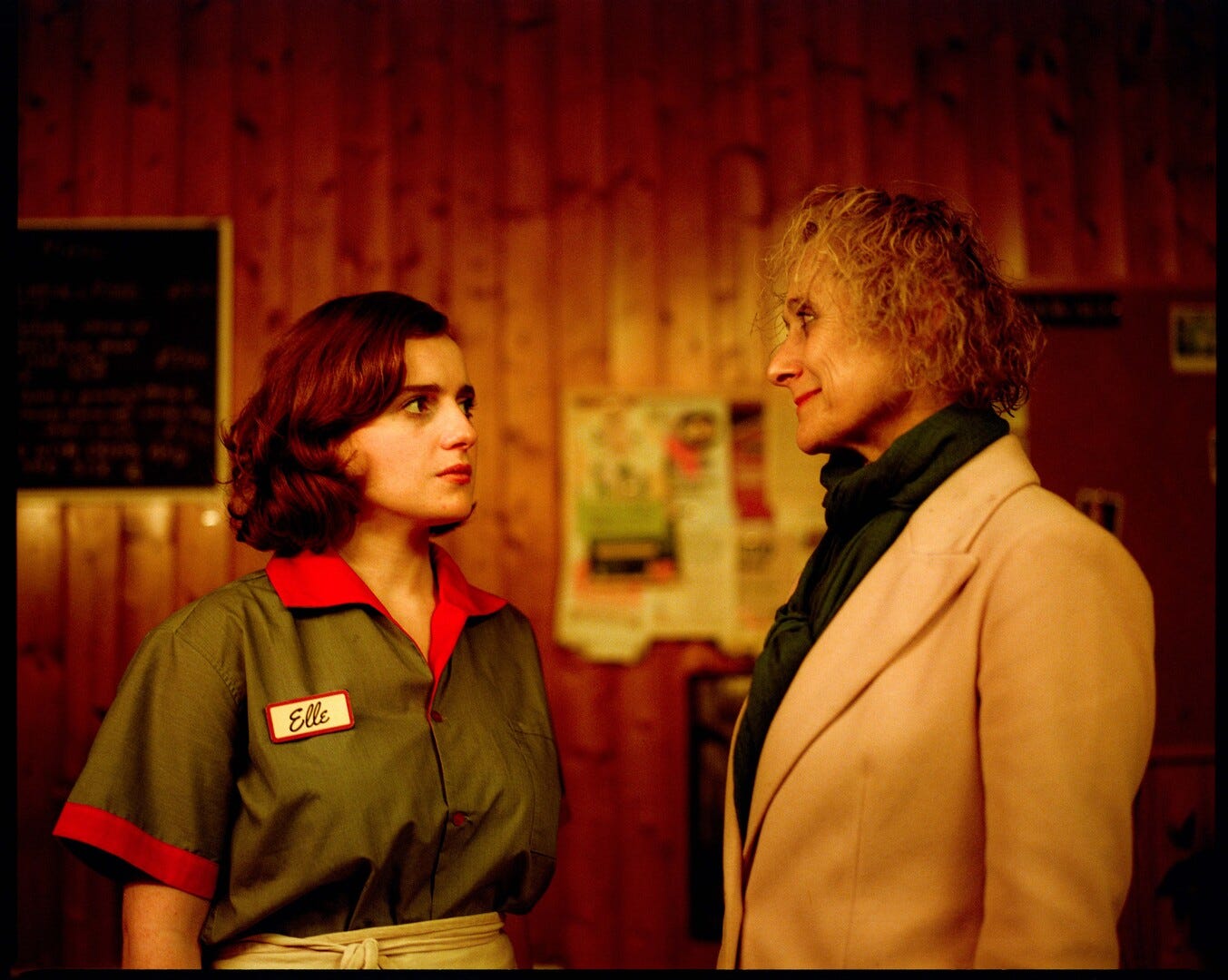
Below, you can read my interview with Jack, where we talk about his process in making the film, his collaborations, and how the film’s success so far has impacted him personally.
Q: I’ve been following your work for a while, and this is not your first experience making a short – you’ve directed and written quite a large body of work. How did it feel to write and direct a drama instead of a comedy? Did you have to adapt your process at all?
“I first had to get out of my own way because when I was starting to write it, I had that little voice in my head that was like, ‘no one’s gonna care about this. You can’t do this. If it’s not funny, no one’s gonna care.’ And that took me a while to get over. But although I’ve been making comedy for the longest time, all of my influences have been outside of comedy. I’m not a big comedy nerd. I’m more of a cinema geek. So whenever I was making comedy, I was using those influences from films that I love. (...) I really wanted to make something that felt more in line with my taste.
As this idea kind of grew, it wasn’t so much that I had to stop myself from making it funny. It was more like I had to convince myself it was worthwhile because it wasn’t funny. I realised that the structure of The Second Time Around is not dissimilar from a comedy sketch in a lot of ways. There are so many examples recently of sketch comedians having gone into feature films that aren’t comedies. Zach Kreger and Jordan Peele don’t stop their characters from being funny. It’s just that the tone of the thing isn’t meant to make you laugh. I didn’t want the characters to not be funny people. That’s why Joan (Caroline Goodall) would undercut the serious moments with some jokes, because I think that’s just how human beings react.”
Q: You can see the progression of your work very easily, especially between your sketches having a setup and a punchline, and graduating to this short. Anyone who has watched your work from Jack and Dean can see that progression.
“Thank you. I’m glad because I obviously don’t want it to feel like ‘where did this come from?’ There are going to be a fair amount of people who have seen my work from the last fifteen years, and I do hope that if they have any interest at all in the stuff that I’ve made, they can still see my fingerprints on The Second Time Around.
Q: When it came to the idea for the story, was it based on an experience or did it just come to you in bits and pieces?
“It first came to me towards the end of lockdown. I had a very complicated relationship with Christopher Nolan’s film Tenet (2020). I delved into the puzzle of it all and started to find all of the emotional threads that it was purposefully hiding. There’s a particular scene, the first time that you see Robert Pattinson and John David Washington on screen together, where there are hints about how Robert Pattinson probably already knows [John David Washington]. But they never bring those hints up to the surface because part of the story is that they suppress everything. I wondered if you could tell a story like that, with that kind of dynamic; where you bring all the emotion up to the surface instead.
Although I’m obsessed with those kinds of concepts and using something impossible and something high concept, my personal taste is when it’s used to express something really human. That’s why I love comedies like Palm Springs (2020), which did a really great job of using the timeloop to express someone stuck in their life, but becoming comfortable in the uncomfortable and not wanting to change it.
Aside from that, one of the first things that inspired me was wondering whether or not you could tell a story about two people of the same gender and if you start kind of implying that there might be something strange going on, if an audience might make assumptions about that dynamic before it’s revealed to be something completely different. As I was writing it and developing it, that became less and less important to me because that relies on there being a twist, and you have to hide all of the context and emotion in order to protect the fact that all you’re trying to do is shock an audience. So as I delved into it more, I brought more of myself into it; my fears and experiences, asking questions like ‘what would I do if I found myself in this situation?’ So it was definitely built brick by brick, and it revealed itself to me over time.”
Q: It’s a very low sci-fi film where the story isn’t so much interested in why the magic exists, but how it interacts with the characters and the plot. What other influences helped you inform or direct you towards that subgenre?
“Tenet was the big boy. I liked the idea that you can move through time, but if something had happened and somebody was there, they were always there. You can’t go back and change things, and so I was writing it in my head with that kind of logic. But like anything, you offer it over to people, and then they can decide what it is that they wanna take from it.”
Q: It feels like a story that could take place in any place and any time. What made you decide to set it in a cafe, and why in the modern day?
“It’s interesting you say that because I’ve spoken to somebody who has said, ‘Where is it set? Because it feels like it’s kind of set nowhere.’ And actually, the intention was to try and design it so that it felt a bit abstract. The cafe, for example, when I wrote it in the script, it was called a ‘timeless cafe’. One of these places that hasn’t updated itself since the eighties or something, and why would it? It’s always been there, and it’s never gonna change. As for it being in a cafe, I tried two strangers meeting on a tube carriage, and then the train gets stuck in a tunnel for ten minutes. It just didn’t feel right. There was just something about the comforting part of a cafe. And it also felt similar to invading someone’s home. It’s one of those places that feels like a really comfortable place to be, but it’s also a very vulnerable place to be. Just the idea as well that if you think about it on an emotional level, the idea of somebody saying ‘I want to be let in’ emotionally and literally, and then that person refusing and seeming a bit apprehensive about that. It was just an instinct to set it in a cafe.”
Q: - I noticed that you’ve worked with the film’s DOP, Ciaran O’Brien, before, and the style of the film is particularly pronounced — do the two of you collaborate on what you want the final product to look like, or is it entirely your vision?
“It comes down to what I wanna do, and then Kieran is really great at technically trying to help me achieve it. And he achieves that by literally doing it when I say, ‘this is what I want’. The biggest influence for the visual style of the film was Long Legs by Osgood Perkins from last year, and so we used the exact same camera and exact same lenses because I liked that beautiful, very wide-angle cinematography that they used. I liked the sodium-y contrast of colours and the deep greens, that sickly kind of look. I thought and hoped that as you watch the film, it goes from feeling like a horror into feeling a lot more cosy and warm just in your mind.
With Ciaran, I told him that was what my references were. Instead of storyboarding it in the traditional way, he uses this game engine where he scans the cafe, and then he can walk a video game character around it and place camera angles. That really helped us map it out, especially because we had no time. It helped us find some very interesting shots that I don’t think we otherwise would have considered.”
Q: We have to talk about the leading performers. Caroline Goodall, in that role, is truly a match made in heaven. What was it about her and Hannah Onslow that made you cast them?
“Well, a big thing for me when I was making this was I wanted to make something super achievable. Ten-minute film, two characters, one location. But I also wanted to give myself challenges for things I hadn’t done before. I wanted to work with a really established, veteran actress who’d had a really great career, and pair her with an up-and-coming actress who’s clearly going to be a star. And I can’t actually believe that I got that thing that I wanted.
Hannah had a friendship with one of my producers, Ash Horne, and he thought she’d be great for this, and I’d seen her in This Is Going to Hurt and her featured role in Empire of Light. So I went and met with her, and she read the script, and we just had a really lovely conversation. She just said it moved her, and then she had such a lovely take on what the concept was doing. She said ‘I think it’s about being present, and my character doesn’t want to be present. She just wants this character to leave, and all this poor woman wants is to have five minutes to be present with me.’
Then Caroline and I met in 2018 on a show that I was on for like a day. I just bugged her with questions about Steven Spielberg and Robin Williams, and she was so lovely about the whole thing. But we stayed in touch since then, on and off. And when I was thinking, ‘Who can we send this to? Who would possibly even read it?’ I was like, ‘Oh my god. ’ It just clicked. And so I went through her agent, and then the next day I was in her living room, she’d read it, and she and I had a fairly brief conversation about it, and then we just caught up for the next couple of hours, but then that was it, she was in the film. I got very, very lucky, especially because Hannah had signed on to do it or agreed to do it in January, and we didn’t shoot until October. It was, like you said, just a match made in heaven.”
Q: Finally, the short has been seeing some pretty insane momentum with its run at festivals, and now there’s a potential for it to be BAFTA nominated. What’s been your personal reaction to this kind of success thus far?
“It’s been very shocking. I don’t feel like I can take it in too much as something that changes how I feel about this thing we’ve made. But it’s lovely, I mean, when we won a HollyShorts award, we won best sci-fi, and that was lovely because it’s nice that the concept at the centre of my story, which is there to tell an emotional, human story, is being recognised. We recently won the best film at the Ealing Film Festival, which was such a surprise because I live in West London, and that felt quite close to home, and we shot it in Ealing as well, so it all felt quite meaningful for that reason. Now, the fact that we are qualified for BAFTA contention is a bonkers thing to think about, and I think it’s a carrot that’s not really… grabbable, but it’s also not impossible because we are in, we are qualified, and you never know.
I’m just satisfied with the fact that people have been enjoying it, and I’m very happy with it. I’m happy it’s out of my head because I would go to sleep imagining the film, and now it’s given me some room to think about a new idea.”
The Second Time Around is playing now on Channel 4 and at upcoming film festivals – check out where and when on the film’s Instagram page.
 | A guest post by
|